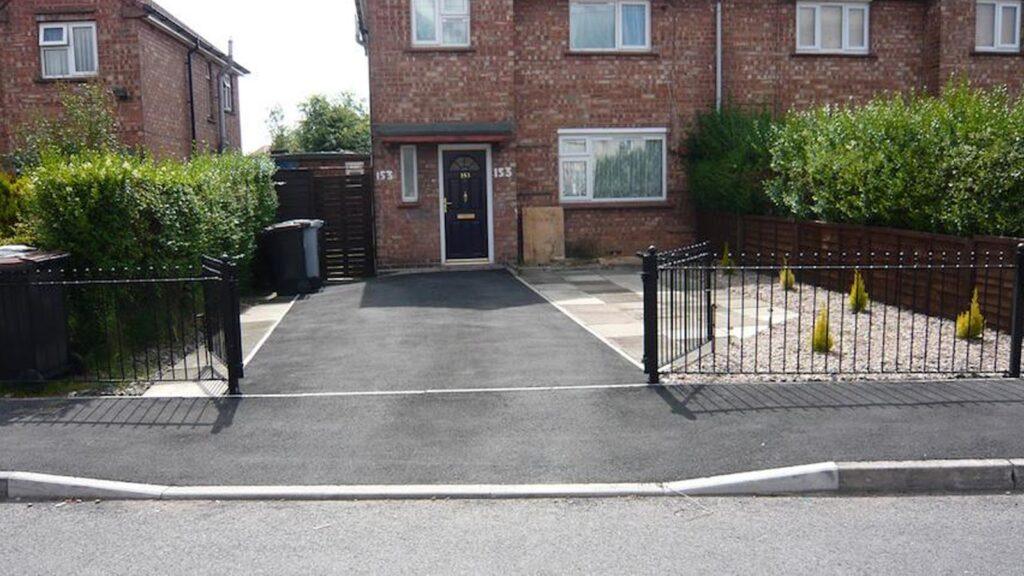

Water running toward the house from a driveway is one of the most damaging and most avoidable problems in domestic landscaping. It is a problem that has become more common across Essex as more front gardens have been replaced with hard standing over the last 30 years, but it is entirely preventable when drainage is properly designed and installed as part of the driveway project.
At PaveRose Driveways and Landscaping, drainage design is the first thing we consider when planning any driveway installation, not the last. We have been solving drainage problems on driveways across Chelmsford, Brentwood, Basildon, Braintree, and the wider Essex region for over 30 years. This guide explains the mechanisms by which driveway runoff damages buildings, the tools available to intercept and manage that water correctly
Why Driveway Runoff Is a Serious Problem
How Water Damages Buildings
Water running from a driveway toward the house poses three distinct risks to the structure. The first is damp penetration. Any hard surface that directs water against a house wall and allows it to sit against the masonry creates conditions for water to find its way through the wall, particularly in older properties where the masonry is porous and the pointing is not perfectly maintained. This can lead to penetrating damp on internal walls, deteriorating plaster, and damage to internal finishes.
The second risk is DPC bridging. Building regulations require that any hard surface adjacent to a house must be at least 150mm below the damp proof course. When a driveway is installed at a level that is too close to or above the DPC, water can bridge the DPC and enter the wall above it, creating a rising damp pathway that bypasses the physical DPC entirely. We check DPC levels on every project before any groundwork begins.
The third risk is foundation saturation. Persistent water pooling against the base of a house wall saturates the ground around the foundations, which can contribute to subsidence in clay soils that expand when wet and contract when dry, a condition known as clay heave that is particularly relevant in Essex where London Clay and similar soil types are widespread.
The Scale of the Problem Across Essex
Essex has one of the highest rates of front garden paving in the East of England. The combination of high car ownership, pressure on on-street parking, and rising housing density has driven a significant increase in domestic hard standing over the last two decades. The consequence is a measurable increase in surface water runoff from residential areas, contributing to local flooding events and increased pressure on the public drainage network.
This is the background context for the planning regulations that now require permeable surfacing or adequate drainage for front garden driveways over five square metres. Understanding these regulations and the practical drainage solutions that satisfy them is important for any homeowner planning a new driveway in Chelmsford or across Essex.
The Fundamental Rules of Driveway Drainage Design
Rule One: Water Must Never Flow Toward the House
This sounds obvious, but it is violated surprisingly often in poorly designed driveways. Every driveway surface must be graded so that water flows away from the house, either toward the street, toward a planted border or lawn, toward a drainage channel, or into a permeable surface from which it can infiltrate the ground. A level or near-level driveway adjacent to a house will always direct some water toward the building in heavy rain.
The minimum acceptable gradient for a driveway surface is 1 in 60, the same as for patios. For driveways this typically means grading toward the street or toward a channel drain at the front of the plot. On steeply sloping plots where the house is downhill from the street, the drainage design requires more careful thought: typically a channel drain across the driveway at the base of the slope, intercepting water before it reaches the house wall.
Rule Two: Water Must Have a Defined Discharge Route
A drainage plan that moves water off the driveway surface but does not give it a clear onward route simply moves the problem. Water intercepted by a channel drain must connect to a discharge point: a soakaway in free-draining ground, a surface water drain, a watercourse, or a lawn or border large enough to absorb the flow. The discharge point must be identified and confirmed as workable before installation begins.
On plots where the ground is heavy clay and a soakaway is not viable, connection to the surface water drain or a pumped discharge solution may be required. We assess drainage options on every site and design the discharge route as part of our pre-installation survey.
Rule Three: Permeable Surfaces Reduce the Problem at Source
A permeable driveway surface, one that allows water to drain through it into the sub-base and ground below, reduces surface runoff to near-zero in moderate rainfall conditions. This fundamentally changes the drainage challenge: instead of managing large volumes of surface water runoff, the design needs only to handle the overflow that exceeds the infiltration capacity of the surface during intense rainfall events.
This is why permeable surfaces are the most effective drainage solution for driveways: they solve the problem at source rather than simply redirecting it. It is also why planning regulations favour permeable surfaces for front garden driveways.
Permeable Driveway Surfaces: How They Work
Resin Bound Surfacing
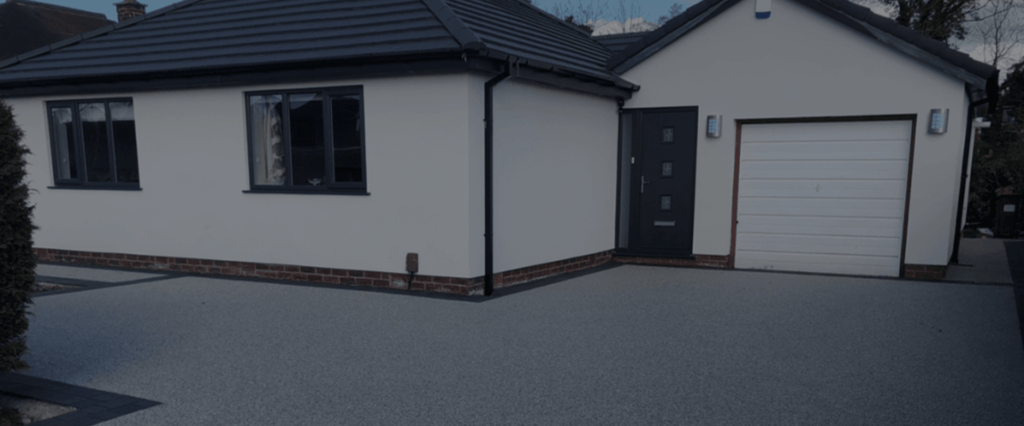
Resin bound surfacing is inherently permeable. The aggregate particles are fully coated in resin and bonded to each other, but the gaps between the particles remain open and allow water to drain through the surface at a rate of approximately 40 to 60 litres per square metre per minute under test conditions. This is far in excess of even the most intense UK rainfall events, meaning a correctly installed resin bound surface will drain all rainfall without generating surface runoff. We discuss resin bound in detail in our comparison of resin vs block paving vs tarmac driveways in Chelmsford.
Permeable Block Paving
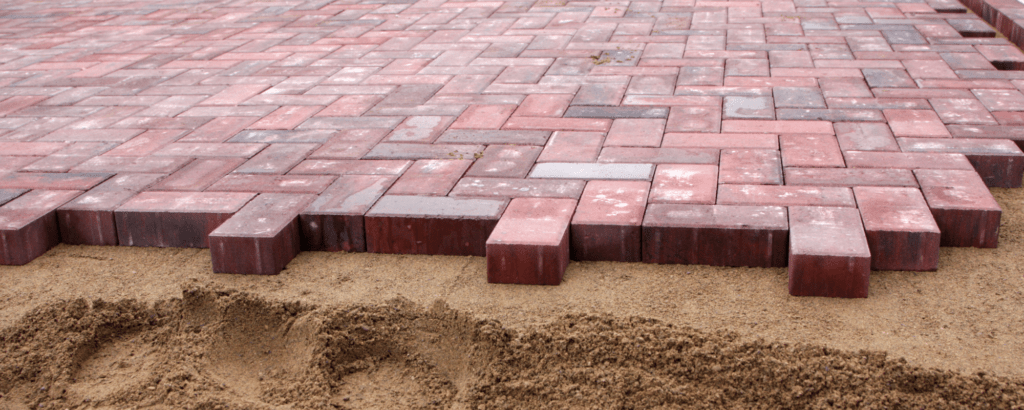
Standard block paving with open, sand-filled joints over a permeable sub-base is classified as permeable surfacing under planning regulations. The joint spaces between the units allow water to drain through into the granular sub-base below, from where it infiltrates the ground. For block paving to function as permeable surfacing, the sub-base must be designed to allow water infiltration, which typically means using a clean stone sub-base rather than a dense-graded aggregate.
Permeable block paving systems with enlarged joints filled with permeable aggregate, or with specially designed units that create larger drainage channels, offer even better drainage performance than standard jointed block paving.
Gravel and Loose Aggregate
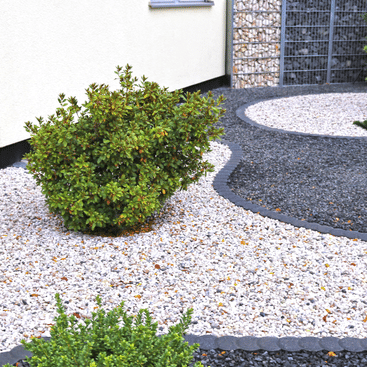
Gravel is the most inherently permeable front garden surface and was the traditional choice for domestic driveways before block paving and tarmac became dominant. A correctly constructed gravel driveway over a permeable sub-base provides excellent drainage with no surface runoff. Its limitations are maintenance (it migrates, needs raking, and requires regular topping up) and the difficulty of using it for pushchairs, wheelchairs, and garden equipment.
Grass Reinforcement Systems
Plastic or concrete grass reinforcement cells, laid over prepared ground and filled with soil or aggregate before seeding with grass, create a load-bearing surface that is almost entirely pervious. They are sometimes used for occasional parking areas at the side of a house, or for second car parking areas where aesthetics favour a planted appearance and the ground is used infrequently enough that the grass can recover between vehicle movements.
Channel Drains for Driveways: Types and Placement
Threshold Channel Drains
A channel drain installed at the base of the slope on a sloping driveway, or at the boundary between the driveway surface and the house wall, intercepts surface water at the point where it would otherwise reach the building. This is the most important and most commonly required channel drain position on any driveway adjacent to a house.
The threshold channel must be set at the lowest point on the driveway, confirmed against the surrounding levels before installation, connected to a discharge pipe, and sized to handle the maximum rainfall intensity across the driveway catchment area. An undersized channel that fills and overflows in heavy rain provides no protection.
Crossfall Channels
On wide driveways, a channel drain installed at right angles to the main drainage direction, typically across the full width of the driveway at one or more points, intercepts water flowing toward the house before it reaches the wall. This is particularly relevant on driveways with a slight toward-house fall that cannot be corrected without significant regrading.
Aco Drain and Proprietary Systems
ACO, Hauraton, and similar proprietary channel drain systems are the most widely used for residential driveway drainage across Essex. They are available in a wide range of grate styles, including stainless steel, ductile iron, heelguard gratings, and polymer slotted covers, that can be matched to the driveway aesthetic. Load class D400 grating is required for vehicle-rated channel drains on driveways.
Soakaways for Driveway Drainage
When a Soakaway Is Appropriate
A soakaway is the preferred discharge solution for driveway drainage in areas where the ground has sufficient permeability to absorb the driveway runoff over time. In free-draining Essex soils, such as the gravelly deposits in parts of Epping Forest District, the Brentwood area, and the terrace gravels around the Chelmer valley, a soakaway of appropriate size will manage driveway drainage effectively.
In Essex clay areas, including much of central and southern Chelmsford, Basildon, and Harlow, soakaway performance is often marginal. A percolation test before installation is essential in these areas. BRE Digest 365 provides the methodology for sizing soakaways based on measured percolation rates, and we carry out percolation assessments as part of our pre-installation survey service.
Soakaway Sizing and Position
A soakaway for a driveway of 40 to 60 square metres in moderate-permeability ground typically requires a volume of 1 to 2 cubic metres. The soakaway must be positioned at least 5 metres from any building and at least 2.5 metres from the property boundary. It must also be below the driveway surface level so that gravity carries water from the channel drain to the soakaway without a pump.
Modern plastic crate soakaways, using geocellular crates wrapped in geotextile membrane, are the most efficient and easiest to install for domestic applications. They offer a high void ratio of approximately 95 percent, meaning a small physical footprint provides a large effective water storage volume.
Driveway Levels and Falls: Getting It Right
Fall Direction on a Standard Driveway
On a standard front driveway that slopes from the house toward the street, the natural fall of the ground already directs water away from the house. The drainage design simply needs to ensure that water flowing off the driveway does not pass onto the public footpath or road (which is not permitted) but is instead intercepted at the front boundary and directed to a soakaway or surface water drain.
A channel drain at the front boundary of the driveway, just inside the pavement edge, fulfils this role. It intercepts all water flowing from the driveway surface toward the street, connects to an underground drain, and prevents the driveway water from contributing to footpath flooding.
Fall Direction on an Adverse Slope (House Lower Than Street)
When the house sits lower than the street, the natural fall of the ground directs both driveway water and street water toward the house. This is a more challenging drainage design scenario that requires a channel drain positioned between the street and the house to intercept water before it reaches the building. The channel drain must be sized generously, as it needs to handle not just the driveway catchment but any overflow from the street during intense rainfall.
On adverse-slope sites, permeable surfacing reduces the volume of water that needs to be managed by the channel drain, because the surface absorbs rainfall rather than generating runoff. The combination of a permeable surface and an intercepting channel drain is the most robust drainage solution for adverse-slope driveways across Essex.
Frequently Asked Questions
Is my driveway responsible for flooding my neighbour’s garden?
If your driveway is impermeable and directs water toward a neighbouring property rather than containing it within your plot or discharging it to an approved drainage point, you may be contributing to a flooding problem that your neighbour is entitled to raise with you. Under the Water Act 2010, landowners have a legal responsibility to manage surface water arising from their land. If your driveway is causing drainage problems for neighbours, a permeable resurfacing or drainage channel installation is the appropriate remedy.
My driveway slopes toward my garage and front door. What are my options?
This is a common situation on plots where the ground falls toward the house. The most effective solution is a channel drain installed immediately in front of the garage door and/or the front door threshold, set at the lowest point of the driveway fall. The channel intercepts water before it can enter the garage or pass under the door. In combination with a permeable surface where possible, this provides reliable protection in all but the most extreme rainfall events.
Do I need a soakaway for a new driveway in Essex?
Not necessarily. If the driveway surface is permeable (resin bound or permeable block paving over a permeable sub-base) and the ground has reasonable permeability, the water infiltrates directly through the surface and sub-base without requiring a separate soakaway. If the surface is impermeable and the ground will not support direct infiltration, a soakaway or surface water drain connection is required. We assess your specific site conditions and recommend the appropriate solution.
What drainage solution does PaveRose use most commonly on Essex driveways?
For new driveways, we specify permeable resin bound or permeable block paving wherever the site allows, as this manages drainage at source and eliminates the need for additional drainage infrastructure in most cases. Where an impermeable surface is specified for practical reasons, or where the existing surface is being retained, we design and install a channel drain and soakaway or surface water drain connection as part of the project.
How much does driveway drainage cost to install?
A single channel drain with a soakaway connection on a standard domestic driveway in the Chelmsford area typically costs between £500 and £1,500 depending on the length of the channel, the distance to the soakaway, and the ground conditions encountered. This is a small cost relative to the total driveway project and is essential for long-term performance. We include drainage design in all our driveway quotations. Contact us for a free site survey and quotation.
Professional Driveway Drainage Design Across Essex
PaveRose Driveways and Landscaping designs and installs driveway drainage systems across Chelmsford, Brentwood, Billericay, Basildon, Braintree, Colchester, Epping, Harlow, Rayleigh, Southend-on-Sea, and all surrounding Essex areas. We carry out site surveys, percolation tests, and drainage design before any groundwork begins, ensuring that every driveway we install drains correctly for its full working life. Contact us today to arrange your free consultation.